
The Intersection of Coal and the Beach

Bulk Carrier Sunrise entering Port of Newcastle passing Nbbby’s Head
The first mention of coal near Newcastle attributes the find to escaping convicts in 1791. By 1797 however Governor Hunter had become more interested in the possibilities for coal exports following confirmation of “a considerable quantity of very good coal, and lying so near the water as to be conveniently shipped…”
It was not until 1800 that Hunter dispatched the Martha – a 170 ton ex-Spanish ship Anna Josepha. It made a number of trips to Coal River between June and October 1800 for cargoes of coal and timber.
In April 1804 Governor Kingston directed the establishment of the new penal settlement at the mouth of the Hunter River. The convicts were put to work at Colliers Point extracting coal and timber. The Governor’s General Order names the settlement Newcastle.
The idea of Newcastle as a ‘coalopolis’ – city of coal – not only matched the historical baggage of its naming but also reflected a desire to encourage investment in coal mining and heavy industry.
Today, the Port of Newcastle is the largest coal port in the world.
As Newcastle grew, the attractions of its ‘sea breezes and convenient bathing’ were recognised by visitors and Commandant Morisset had the Commandant’s Baths (Bogey Hole) dug from the rock in about 1820.

Bogey Hole
Although the benefits of swimming were becoming more popular, in the mid 19th century bathing enclosures were preferred (to the open beach) and by 1850 bathing accommodation for ladies was also built between Nobbys and the ballast wharf. The Soldiers Baths at the foot of Signal Hill and other baths were built, seen as more comfortable than the open water.
Newcastle’s picturesque setting and its embrace of the benefits of bathing had encouraged its early boosters to associate it with the recuperative image of England’s Brighton. ‘Invalids and families’ were encouraged to take advantage of Newcastle’s salubriousness.
In the 19th-century concerns about decency and morality led to laws banning swimming in daylight hours. In 1902 William Gocher advertised that he would swim at Manly in Sydney in protest against the law. He was not arrested. Similar protests occurred at other beaches but police were reluctant to arrest the bathers as long as they were decently clothed.


The Newcastle Ocean Baths, completed construction in 1922, adding pavilions, pools and promenades as well as the Striped Classical / Art Deco facade and bleacher seating to the basin that opened in 1913. The Young Mariner’s Pool, now known as the Canoe Pool was completed in 1957. In 1959 an additional pool was constructed adjacent to the geographical pool to sail canoes. Underneath all that sand is a map of the world.
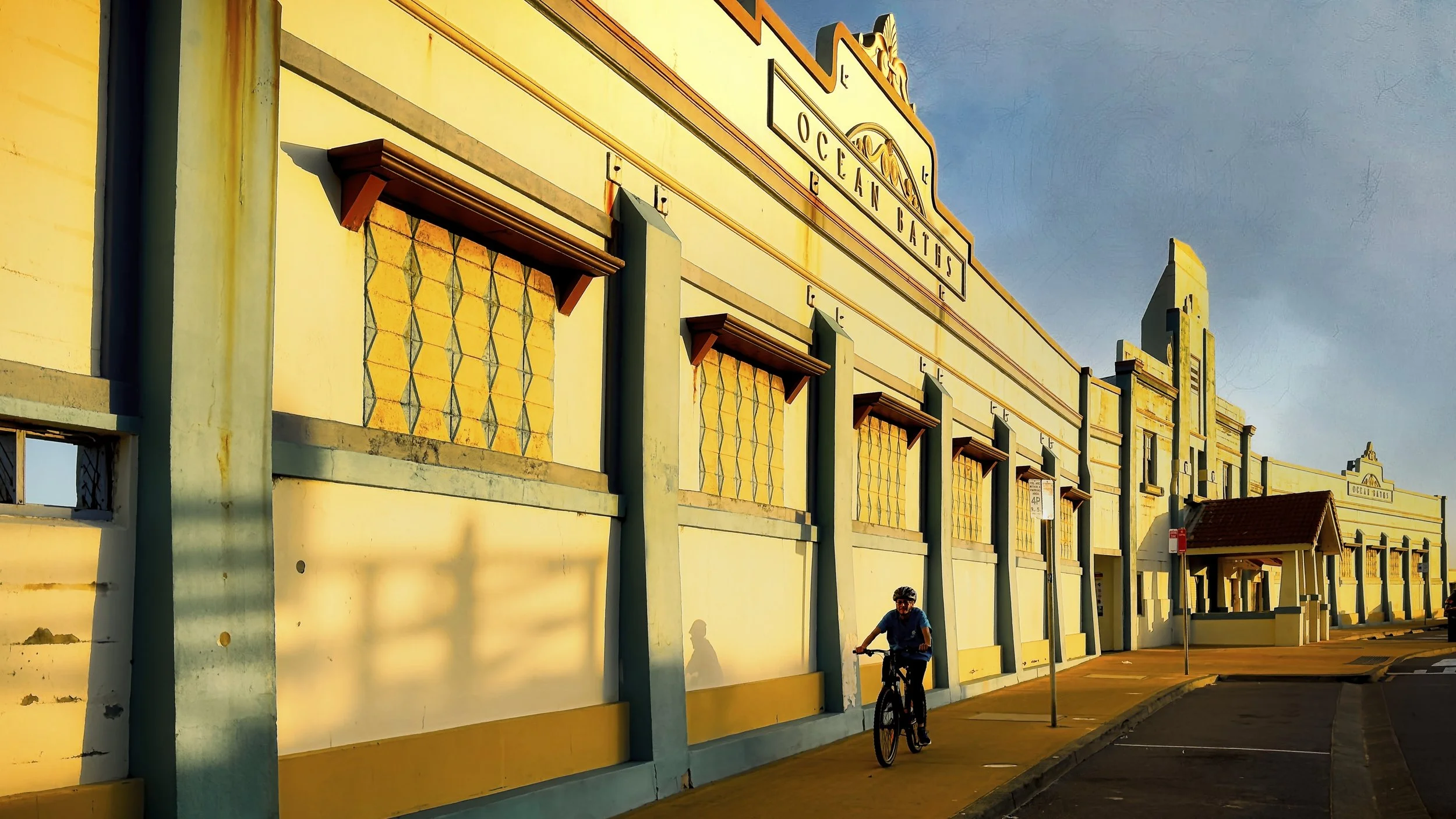
Facade of Newcastle Ocean Baths

Canoe Pool
Dr Nancy Cushing, at the University of Newcastle, described the beach as “one of Newcastle’s hidden places” - not because of its lack of visibility but because of its cultural significance to the city. Cushing notes that “For most of the nineteenth century the beach was a place of ambivalence, one hidden from the purview of respectable people … [and] … the foolhardy were prevented from engaging in sea bathing by government regulations and social pressure.”This inscription has been stencilled into the wall at Nobby’s Beach - a beach created by the construction of a pier to service Coal Island, now called Nobby’s Head.

Nobby’s Beach looking towards Nobby’s Head

Nobby’s Head
Macquarie’s Pier (and its successor) was a major contributor to the development of the port, but the accretion of sand to the east effectively created Nobby’s Beach.

Silver Nova Cruise Ship passes Nobby’s Head. Photo from Newcastle Ocean Baths.
Intrinsic to both the beach and coal is Nobby’s Head. It contributes a perfect punctuation point – this landmark icon of Newcastle marks both the sea-entry to the Port of Newcastle with its coal loaders and other terminals but also the start of Bathers Walk with its beaches and baths extending 5 kilometres down to Mereweather Ocean Baths (opened in 1935) and beyond.

But what does the future hold?
The future of Newcastle is a transition away from its historic reliance on coal to one of significant economic diversification, as the long-term outlook for coal is one of decline. The planned closure of coal-fired power stations in the region by 2033, as well as reduced investment in and replacement of ageing coal fired power stations around the world are major factors driving this decline.
While the Port of Newcastle works on diversification strategies with plans for a Clean Energy Precinct to support the export of renewable energy products like green ammonia and hydrogen, effectively reimagining land once earmarked for coal terminals, Newcastle's strategy is much broader, focusing on a knowledge-based and services-led economy.




Tourism contributes around 6-7% of Newcastle's Gross Regional Product but liveability will drive population and economic growth including in healthcare, education, and professional services, becoming the core of Newcastle's future diversified economy.

The beach is at the intersection of that future vision.
References:
1. Newcastle’s Historic Swimming Baths, University of Newcastle. Livinghistories.newcastle.edu.au
2. The Rise and Fall of the Newcomen-Street Corporation Baths: Newcastle’s White Elephant, hunterlivinghistories.com.au
3. Coal River Conservation and Tourism Management Plan, The City of Newcastle Management Plan, Boyce Pizzey Strategic / Convergence Design (2007), hunterlivinghistories.com.au